The Implosion
About winter end time weeks in the Wirecard courtroom
April 4, 2025
1773669397


Dark Mode
Listen to this article
The Implosion


If a room or object is sealed airtight from the outside world and is destroyed by an external force, the result is not an explosion, but an implosion inward. This is usually much less dangerous to outsiders than an explosion to the outside. The vacuum in such an implosion sucks air into the space with the destroyed mass and causes internal devastation. Just in that sense, an implosion of the various legal proceedings surrounding the Wirecard scandal in Munich, which can probably be described as final, took place in a not dissimilar manner in the very last weeks of winter 2025. The first signs of the implosion were already visible at the end of February 2025, when Tobias Rittel, a Special Task Force witness of the Munich police, who was important for the Wirecard prosecution in mid-2020, testified.


Rittel stated in his interrogation on the 20th and 21th of February 2025, that EY's auditors were consistently quite impressed with Henry O'Sullivan's multi-storey office in Singapore. Which is why the balances in the trust accounts with and at OCBC Bank there were apparently considered quite safe. The Sonder-Kommission (SoKo) employee also stated on February 20, 2025 that he had looked at the accounts of key TPA partners and companies, e.g. those of Al-Alam, Senjo, Centurion, FirstLine. Rittel had overlaid account data and checked which payments of 1 million euros or more were going back and forth. Based on this research, he had, quote, "drawn up a list of companies in consultation with the Munich public prosecutor's office", which was referred to as a "green list". However, only those companies with a high chance of receiving a request for legal assistance were included in this list, i.e. in the vast majority of cases for those in Europe. The important and essential companies, particularly in Dubai, Singapore and Manila, were apparently happily set aside from the very beginning in July 2020. Just like a money laundering report from the FIU authority of the German Customs Police dated July 15, 2020 - the exact day when the Dubai managing director Oliver Bellenhaus was called as a key or crown witness during an interrogation at the Munich public prosecutor's office. The FIU report concerned Oliver Bellenhaus' own Levantine Foundation in Liechtenstein. SoKo employee Rittel stated that he saw the FIU report sometime a few weeks later, although it was sent directly to the Criminal Investigation Department 72 in Munich and also to the Munich Public Prosecutor's Office by fax on July 15, 2020.
When questioned by former CEO Dr. Braun, Rittel stated that he did not know Oliver Bellenhaus' rank in the company (managing director), nor what the actual motive had been for falsifying the entire business of Wirecard AG and its subsidiaries - nor whether this question of motive was important to him or others. The SoKo employee explained he had noticed briefly on a sidenote that Wirecard associated firm Centurion had more than one billion euros in its accounts.
Just one week later, Hildegard Bäumler-Hösl, the senior public prosecutor responsible for Wirecard matters for many years, was finally questioned. On the first day, she stated that the key witness had often been conspicuous in money laundering matters in the past. The senior public prosecutor found it quite surprising that key witness Bellenhaus - about whom a money laundering report concerning his own Levantine Foundation in Liechtenstein arrived just a few meters away at exactly the same time - stated that Wirecard's third-party partner business had been completely and utterly fictitious. Everything "grew and grew, and there was no end to it", according to Bavaria's chief prosecutor for Wirecard, although she never actually got to see the company's electronic data. Long responsible for a number of criminal charges relating to Wirecard, the third-party partner business was allegedly completely new to her back in July 2020.
On the second day of her hearing, Bäumler-Hösl revealed no less implosive facts. She explained that in mid-July of 2020, Senior Public Prosecutor Bühring had been on summer vacation, which was why she had stepped in. Bühring apparently only returned to his office on July 20, but did not hesitate to sign the arrest warrants against the Wirecard directors Dr. Braun, Burkhard Ley and Stephan von Erffa within 24 hours, which were executed on the morning of July 22, 2020. At this point, however, the extensive transcripts of the interrogation of the key witness Bellenhaus from some days earlier were still far from being written. At least the Chief Public Prosecutor was able to clarify that the FIU's money laundering report of July 15, 2020 had been processed by Public Prosecutor Lemmers.
Bäumler-Hösl was also responsible for the numerous inquiries of the Berlin investigative committee and surprisingly informed the defense that she was not actually located at the Munich headquarters of the public prosecutor's office on Nymphenburger Strasse, but about 15 minutes' walk away in a branch office on Schleißheimer Strasse.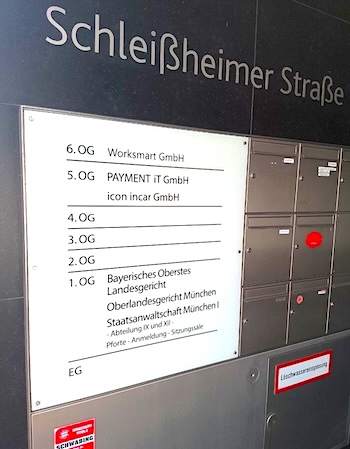
BayObLG and Munich Public Prosecutor's Office on Schleißheimer Strasse Coincidentally or not, this is also the location of the Bavarian Supreme Court, which will be discussed below. In the middle of the second day of the hearing of Public Prosecutor Bäumler-Hösl on February 27, 2025, and after a good two years of criminal proceedings, the Munich Regional Court actually dropped some of the initial Public Prosecutor's charges from the time after mid-2020, mostly related to the granting of loans related to Wirecard's partner company oCap. This immediately led to motions for the dismissal of all judges, magistrates and substitute judges by Dr. Braun, joined by the former chief accountant von Erffa. Like almost all such motions by the defense before, these were swept off the table and rejected a few weeks later.
Although the vacuum of the Wirecard criminal proceedings in this sense had already penetrated as far as the substitute and second judges, the final hammer fell one day after Hildegard Bäumler-Hösl's hearing. In addition to the Wirecard criminal proceedings, there are other Wirecard-related court proceedings taking place exclusively in Munich. One of these proceedings concerns the many defrauded investors who are claiming damages, in particular from the auditing company EY. Three years ago, a Bavarian model plaintiff was selected to represent thousands of former Wirecard investors who presented their claims in the so-called Capital Investor Model Proceedings, or KapMUG in German.
At that time, three years ago, a legal framework was initially drawn up within which the proceedings were to be conducted. However, instead of swiftly waving these framework conditions for the KapMUG proceedings through within a few weeks, the various Bavarian royal courts in Munich took a very long time. After years of a ping-pong game between the regional court, the higher regional court and in particular the aforementioned Bavarian Supreme Court in Munich, it was now, when three years had passed and exactly one day after the interrogation of Senior Public Prosecutor Bäumler-Hösl, decided to largely reject this framework for the KapMUG proceedings. The actual proceedings and a possible decision on any kind of compensation for the many defrauded investors have not even really begun. The not entirely impossible intention of more or less the entire Bavarian judiciary to deliberately delay the KapMUG proceedings from the outset so that they can reach the statute of limitations in mid-2025 with all their might is of course still on the table even after a Wirecard implosion.
The fact that the criminal proceedings against the former CEO Markus Braun, the former chief accountant von Erffa and the Dubai status holder and managing director of Wirecard, Oliver Bellenhaus, have now been dragging on for two and a half years is also helpful in the case of a possible deliberate delay of the proceedings. Mr. Braun's legal insurance had already reached its limit in the spring of 2024. After almost one and a half year of litigation, the expensive defense law firm was simply no longer authorized and could not continue its work after many months of full-time work. For some time now, the former Wirecard CEO has had two dedicated, sometimes very quiet and frustrated public defenders from Middle-earth standing by his side as events unfold in the courtroom.
The facts around February 2025 were also given an international spin when the Financial Times in London, apparently fully aware of its Wirecard roots, suddenly came out first on March 7, 2025 with the news that three Bulgarian spies had been convicted for spying on US military installations as close friends of fugitive Jan Marsalek. The former Wirecard COO was neither charged nor convicted, but it seems that this timely court ruling fit right into the Wirecard calendar in Munich. Instead of reporting on the scandalous facts of the Bavarian prosecution from the days before, one or the other radio news program in Germany decided to simply explain the verdict from London to an audience of millions that day, for example the Deutschlandfunk.
One week after these implosive facts, mostly from the Bavarian prosecutors at the end of February 2025, a renowned economics professor took the witness stand. This professor sat in the courtroom regularly from the beginning of the trial, hardly ever asking any question at all. Already on March 13, 2025, during the first presentation of his 2000-page expert report, Professor Hauser explained that he and his approximately 5 employees often had to extrapolate the company figures of the 50 global Wirecard subsidiaries because data was not always available for each year. For the individual Wirecard subsidiaries, the reporting date of June 15, 2018 was used to calculate the respective company value in the expert report.
Between the first day of Professor Hauser's testimony and his more historic appearances a little later, two BaFin Banking-Authority witnesses appeared on March 26 and 27, 2025. The two Germans stated that, on the one hand, they had openly agreed with Munich's public prosecutors on the historic ban on short sales of Wirecard shares from 2019 in order to prevent speculation on falling share prices of the then super-successful company. On the other hand, just one year later, they also agreed on the mass-media-supported billboarding of Wirecard as a fraudulent bubble, when suddenly all of the company's sales were to be fictitious from June 18, 2020 at the latest.
In the middle of the very last winter days in Munich, during the interrogation of BaFin employee Sebastian Simmer, another implosive surprise was in store that nobody really expected - especially not the mass media journalists who had been making themselves scarce for weeks. After witness Simmer had already been excused from the witness stand, the vacuum-like silence in the underground courtroom in Munich-Stadelheim was finally shattered when Dr. Braun's public defender inconspicuously asked the court if and when the four to five Swiss witnesses would finally be heard. She was referring to the renewed questioning of employees of those companies who are alleged to have been involved in withdrawing at least 340 million euros in Wirecard proceeds and parking them in tax havens long before the company went into insolvency.
The judge said succinctly that in his opinion this was rather annoying and not very profitable, as the witnesses from Switzerland with reference to Monterosa Services AG and Credit Suisse had already been questioned in writing. The judge went on to say that this was really problematic in general, as four to five cantons in Switzerland would have to be contacted, which would then have to decide whether and how a video conference would take place, during which no notes could be taken in the court in Munich.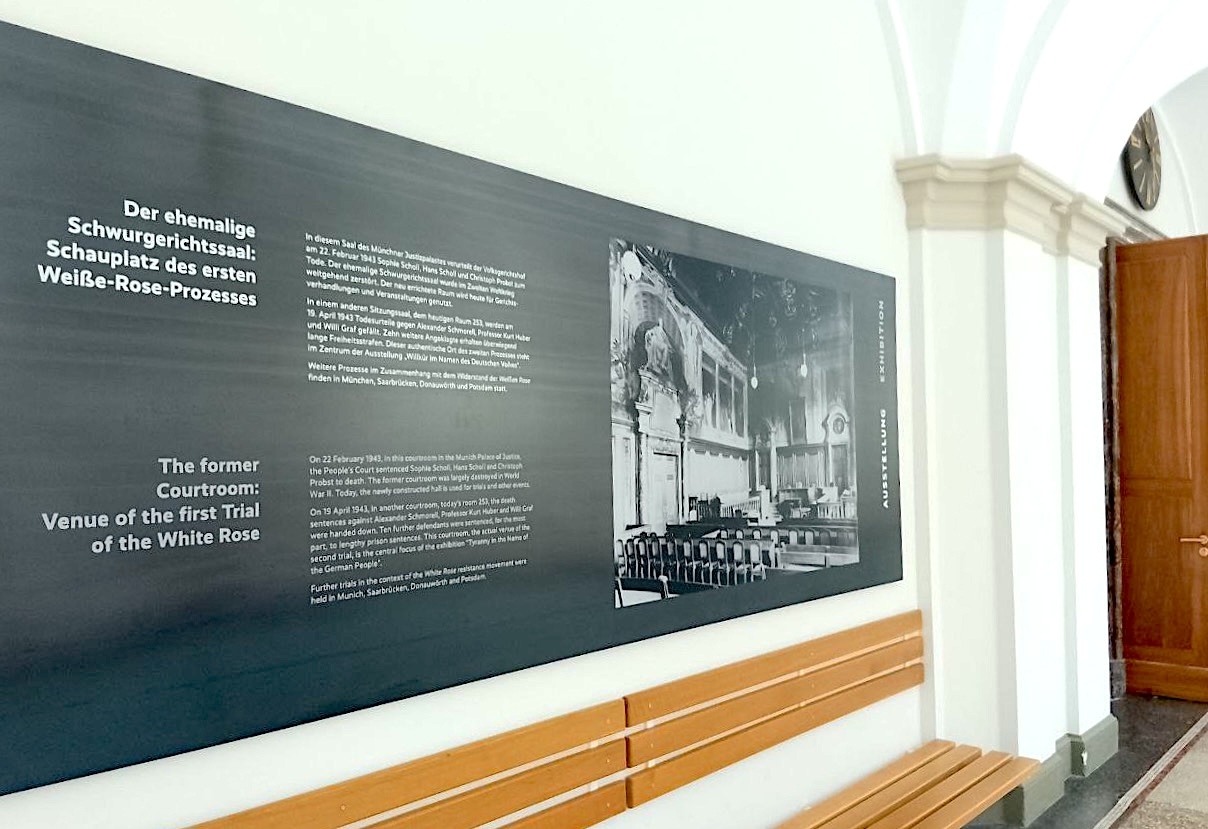
Historic courtroom in the Munich Palace of Justice The submission of Dr. Braun's defence lawyer that one of the witnesses had already certified in writing that 340 million had passed through his company in Switzerland did not seem particularly important to the judge. Oh yes, and the very high court would send an invitation to Wirecard's all-important bankruptcy trustee Jaffe if, quote, "they have time there at some point".
In the first week of April, the economics professor and his 2,000-page report were presented again. His statements of April 2, 2025, in which the renowned expert read from his report that several Wirecard subsidiaries were worth many hundreds of millions of euros and did not give the impression of a fictitious airshed after 2020, were no April Fool's joke. The final act in the implosion of the Wirecard criminal case was the historic April 3, 2025, however. On that day, exactly 80 years ago, Vienna's New Town had just been liberated by the Russian army, and so it was no surprise that the trial on that day did not take place in the brand-new courtroom of the Stadelheim prison, as usual, but in room 270 of the Palace of Justice in downtown Munich - the very same room, by the way, in which the founders of the White Rose Nazi resistance movement, Hans and Sophie Scholl, were sentenced to death in 1943.
Finally, it was the defense's turn to question the expert witness. The highlight of April 3, 2025, was a bizarre, almost 30-minute ping-pong discussion between Judge Födisch, Professor Hauser and the questioning ex-chief accountant Stephan von Erffa about why the economist had not corrected some of his methods and procedures after valuing the Wirecard subsidiary in Brazil at only 7 million euros in his expensive expert opinion, while the insolvency administrator had achieved a whopping 54 million euros - almost eight times the value of the expert opinion. The very German economic expert and the even more German judge seriously tried to convince those present that they did not understand such a question at all. In the further diluted conviction of their final judiciary victory in the Bavarian court, they tried for a good half hour to prevent the former Wirecard chief accountant from receiving an appropriate answer to his question with all tricks and evasive maneuvers imaginable.
Dr. Braun, who remains in prison for almost 5 years now despite any court verdict so far, asked how the expert could arrive at a loss of around 500 million euros in his expert opinion if Wirecard Acquiring and Issuing were worth 860 million euros, Wirecard North America 450 million euros, Wirecard Bank 285 million euros, WSI 300 million euros and Wirecard Brazil 54 million euros. You can't calculate like that, said the economics professor.
The journalist reporting here was the only one of his kind in the court room. Pretty implosive, after all.

Copied
00:00
Rittel stated in his interrogation on the 20th and 21th of February 2025, that EY's auditors were consistently quite impressed with Henry O'Sullivan's multi-storey office in Singapore. Which is why the balances in the trust accounts with and at OCBC Bank there were apparently considered quite safe. The Sonder-Kommission (SoKo) employee also stated on February 20, 2025 that he had looked at the accounts of key TPA partners and companies, e.g. those of Al-Alam, Senjo, Centurion, FirstLine. Rittel had overlaid account data and checked which payments of 1 million euros or more were going back and forth. Based on this research, he had, quote, "drawn up a list of companies in consultation with the Munich public prosecutor's office", which was referred to as a "green list". However, only those companies with a high chance of receiving a request for legal assistance were included in this list, i.e. in the vast majority of cases for those in Europe. The important and essential companies, particularly in Dubai, Singapore and Manila, were apparently happily set aside from the very beginning in July 2020. Just like a money laundering report from the FIU authority of the German Customs Police dated July 15, 2020 - the exact day when the Dubai managing director Oliver Bellenhaus was called as a key or crown witness during an interrogation at the Munich public prosecutor's office.
When asked by the former CEO Dr. Braun, the Special Task Force witness of the Munich police stated that he did not know Oliver Bellenhaus' rank in the company, nor what the actual motive for falsifying the entire business of Wirecard AG and subsidiaries would have been.
When questioned by former CEO Dr. Braun, Rittel stated that he did not know Oliver Bellenhaus' rank in the company (managing director), nor what the actual motive had been for falsifying the entire business of Wirecard AG and its subsidiaries - nor whether this question of motive was important to him or others. The SoKo employee explained he had noticed briefly on a sidenote that Wirecard associated firm Centurion had more than one billion euros in its accounts.
Just one week later, Hildegard Bäumler-Hösl, the senior public prosecutor responsible for Wirecard matters for many years, was finally questioned. On the first day, she stated that the key witness had often been conspicuous in money laundering matters in the past. The senior public prosecutor found it quite surprising that key witness Bellenhaus - about whom a money laundering report concerning his own Levantine Foundation in Liechtenstein arrived just a few meters away at exactly the same time - stated that Wirecard's third-party partner business had been completely and utterly fictitious. Everything "grew and grew, and there was no end to it", according to Bavaria's chief prosecutor for Wirecard, although she never actually got to see the company's electronic data. Long responsible for a number of criminal charges relating to Wirecard, the third-party partner business was allegedly completely new to her back in July 2020.
On the second day of her hearing, Bäumler-Hösl revealed no less implosive facts. She explained that in mid-July of 2020, Senior Public Prosecutor Bühring had been on summer vacation, which was why she had stepped in. Bühring apparently only returned to his office on July 20, but did not hesitate to sign the arrest warrants against the Wirecard directors Dr. Braun, Burkhard Ley and Stephan von Erffa within 24 hours, which were executed on the morning of July 22, 2020. At this point, however, the extensive transcripts of the interrogation of the key witness Bellenhaus from some days earlier were still far from being written. At least the Chief Public Prosecutor was able to clarify that the FIU's money laundering report of July 15, 2020 had been processed by Public Prosecutor Lemmers.
Bäumler-Hösl was also responsible for the numerous inquiries of the Berlin investigative committee and surprisingly informed the defense that she was not actually located at the Munich headquarters of the public prosecutor's office on Nymphenburger Strasse, but about 15 minutes' walk away in a branch office on Schleißheimer Strasse.
BayObLG and Munich Public Prosecutor's Office on Schleißheimer Strasse
Although the vacuum of the Wirecard criminal proceedings in this sense had already penetrated as far as the substitute and second judges, the final hammer fell one day after Hildegard Bäumler-Hösl's hearing. In addition to the Wirecard criminal proceedings, there are other Wirecard-related court proceedings taking place exclusively in Munich. One of these proceedings concerns the many defrauded investors who are claiming damages, in particular from the auditing company EY. Three years ago, a Bavarian model plaintiff was selected to represent thousands of former Wirecard investors who presented their claims in the so-called Capital Investor Model Proceedings, or KapMUG in German.
At that time, three years ago, a legal framework was initially drawn up within which the proceedings were to be conducted. However, instead of swiftly waving these framework conditions for the KapMUG proceedings through within a few weeks, the various Bavarian royal courts in Munich took a very long time. After years of a ping-pong game between the regional court, the higher regional court and in particular the aforementioned Bavarian Supreme Court in Munich, it was now, when three years had passed and exactly one day after the interrogation of Senior Public Prosecutor Bäumler-Hösl, decided to largely reject this framework for the KapMUG proceedings. The actual proceedings and a possible decision on any kind of compensation for the many defrauded investors have not even really begun.
The fact that the criminal proceedings against the former CEO Dr. Markus Braun, the former chief accountant von Erffa and the Wirecard managing director Oliver Bellenhaus have now been dragging on for two and a half years is also helpful in delaying the proceedings.
The fact that the criminal proceedings against the former CEO Markus Braun, the former chief accountant von Erffa and the Dubai status holder and managing director of Wirecard, Oliver Bellenhaus, have now been dragging on for two and a half years is also helpful in the case of a possible deliberate delay of the proceedings. Mr. Braun's legal insurance had already reached its limit in the spring of 2024. After almost one and a half year of litigation, the expensive defense law firm was simply no longer authorized and could not continue its work after many months of full-time work. For some time now, the former Wirecard CEO has had two dedicated, sometimes very quiet and frustrated public defenders from Middle-earth standing by his side as events unfold in the courtroom.
The facts around February 2025 were also given an international spin when the Financial Times in London, apparently fully aware of its Wirecard roots, suddenly came out first on March 7, 2025 with the news that three Bulgarian spies had been convicted for spying on US military installations as close friends of fugitive Jan Marsalek. The former Wirecard COO was neither charged nor convicted, but it seems that this timely court ruling fit right into the Wirecard calendar in Munich. Instead of reporting on the scandalous facts of the Bavarian prosecution from the days before, one or the other radio news program in Germany decided to simply explain the verdict from London to an audience of millions that day, for example the Deutschlandfunk.
One week after these implosive facts, mostly from the Bavarian prosecutors at the end of February 2025, a renowned economics professor took the witness stand. This professor sat in the courtroom regularly from the beginning of the trial, hardly ever asking any question at all. Already on March 13, 2025, during the first presentation of his 2000-page expert report, Professor Hauser explained that he and his approximately 5 employees often had to extrapolate the company figures of the 50 global Wirecard subsidiaries because data was not always available for each year. For the individual Wirecard subsidiaries, the reporting date of June 15, 2018 was used to calculate the respective company value in the expert report.
Between the first day of Professor Hauser's testimony and his more historic appearances a little later, two BaFin Banking-Authority witnesses appeared on March 26 and 27, 2025. The two Germans stated that, on the one hand, they had openly agreed with Munich's public prosecutors on the historic ban on short sales of Wirecard shares from 2019 in order to prevent speculation on falling share prices of the then super-successful company. On the other hand, just one year later, they also agreed on the mass-media-supported billboarding of Wirecard as a fraudulent bubble, when suddenly all of the company's sales were to be fictitious from June 18, 2020 at the latest.
In the middle of the very last winter days in Munich, during the interrogation of BaFin employee Sebastian Simmer, another implosive surprise was in store that nobody really expected - especially not the mass media journalists who had been making themselves scarce for weeks. After witness Simmer had already been excused from the witness stand, the vacuum-like silence in the underground courtroom in Munich-Stadelheim was finally shattered when Dr. Braun's public defender inconspicuously asked the court if and when the four to five Swiss witnesses would finally be heard. She was referring to the renewed questioning of employees of those companies who are alleged to have been involved in withdrawing at least 340 million euros in Wirecard proceeds and parking them in tax havens long before the company went into insolvency.
The judge said succinctly that in his opinion this was rather annoying and not very profitable, as the witnesses from Switzerland with reference to Monterosa Services AG and Credit Suisse had already been questioned in writing. The judge went on to say that this was really problematic in general, as four to five cantons in Switzerland would have to be contacted, which would then have to decide whether and how a video conference would take place, during which no notes could be taken in the court in Munich.
Historic courtroom in the Munich Palace of Justice
In the first week of April, the economics professor and his 2,000-page report were presented again. His statements of April 2, 2025, in which the renowned expert read from his report that several Wirecard subsidiaries were worth many hundreds of millions of euros and did not give the impression of a fictitious airshed after 2020, were no April Fool's joke. The final act in the implosion of the Wirecard criminal case was the historic April 3, 2025, however. On that day, exactly 80 years ago, Vienna's New Town had just been liberated by the Russian army, and so it was no surprise that the trial on that day did not take place in the brand-new courtroom of the Stadelheim prison, as usual, but in room 270 of the Palace of Justice in downtown Munich - the very same room, by the way, in which the founders of the White Rose Nazi resistance movement, Hans and Sophie Scholl, were sentenced to death in 1943.
Finally, it was the defense's turn to question the expert witness. The highlight of April 3, 2025, was a bizarre, almost 30-minute ping-pong discussion between Judge Födisch, Professor Hauser and the questioning ex-chief accountant Stephan von Erffa about why the economist had not corrected some of his methods and procedures after valuing the Wirecard subsidiary in Brazil at only 7 million euros in his expensive expert opinion, while the insolvency administrator had achieved a whopping 54 million euros - almost eight times the value of the expert opinion. The very German economic expert and the even more German judge seriously tried to convince those present that they did not understand such a question at all. In the further diluted conviction of their final judiciary victory in the Bavarian court, they tried for a good half hour to prevent the former Wirecard chief accountant from receiving an appropriate answer to his question with all tricks and evasive maneuvers imaginable.
Dr. Braun, who remains in prison for almost 5 years now despite any court verdict so far, asked how the expert could arrive at a loss of around 500 million euros in his expert opinion if Wirecard Acquiring and Issuing were worth 860 million euros, Wirecard North America 450 million euros, Wirecard Bank 285 million euros, WSI 300 million euros and Wirecard Brazil 54 million euros. You can't calculate like that, said the economics professor.
The journalist reporting here was the only one of his kind in the court room. Pretty implosive, after all.
Leave a comment:
Send
Send
Recommended:

September 17, 2024
Wirecard Sacked
The Court Proceeding - Season 1, Episode 1

August 25, 2024
The Wirecard Summer Gap
About extorted confessions and Bavarian radio news

July 22, 2024
Hotel Wirecard
About broccoli and roastbeef in Munich hotel rooms

June 28, 2024
Money launding is not my thing
About Commerzbank and cancelled Wirecard credit lines

July 3, 2024
Wirecard Chances
About supervisory board advising lawyers

June 20, 2024
The Wirecard PR Court
About an obscure questioning of a Wirecard lawyer

May 15, 2024
Wirecard Rogue
About crazy judiciary talks and on-target court motions

May 25, 2024
Wirecard Untangled
About unsolved issues in Germany's master finance scandal

April 29, 2024
All Inside The Singapore Folder
About Wirecard book keepings an email conversations

April 25, 2024
Grand Vision Trust
A Wirecard Bank Director and Relationship Managements

April 19, 2024
Mount Interim
About a Wirecard interim-CEO on a Swiss rose mountain

April 3, 2024
Harvesting Wirecard
About Swiss roses and Wirecard bears

March 29, 2024
The PayLondon Group
About bears from London and Wirecard targetings

March 24, 2024
Mount Acronis
About a Swiss IT sponsor and Wirecard entanglements

March 15, 2024
Magic Pav
About a Wirecard whistleblower and magic law firms

February 13, 2024
The Trial
About a Wirecard release of prisoner and Franz Kafka's unfinished works

October 4, 2023
Mount Wirecard
About Swiss Wirecard entanglements and the remains of Crypto AG

August 22, 2023
Wirecard Court Halftime
About seven months in Munich Stadelheim and the miracle of Bern

May 18, 2023
Pandora's Box
About Wirecard's IT Architectures

April 29, 2023
The Third Man
About Wirecard's interim CEO James Freis and nice shoes

December 8, 2022
Deflective Attorneys
About a five hours Wirecard indictment

February 18, 2021
Bavariacard
About a Germanic Wirecard Poker

May 5, 2021
A Munich Fraud
Wirecard and Munich's Public Prosecutor's Office

November 22, 2021
Royal Courts of Wirecard
About a Wirecard Lawsuit and Quantum Physics

October 1, 2021
Brilliant Consultants
About Wirecard's financial auditors and the chess game

November 6, 2021
Back To The Wirecard
About the roots of the insolvent German payment provider

April 15, 2021


